 Posts with this logo use


April 29, 2026
Quantum Mechanics of the Inverse Cube Force Law
Posted by John Baez

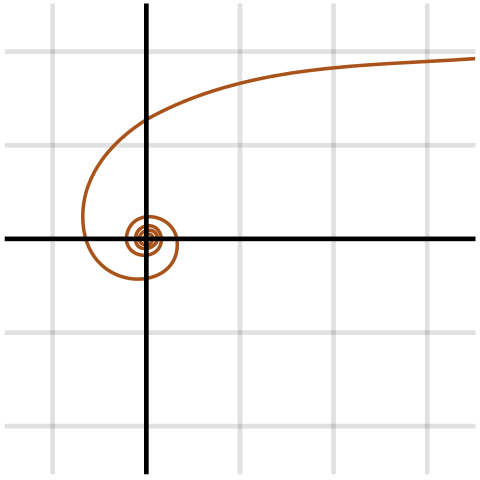
In the last episode of my column in Notices of the American Mathematical Society, we looked at a particle moving in an attractive central force whose strength is proportional to the inverse cube of the distance from the origin. Among other things, we saw that a particle moving in such a force can spiral in to the origin in a finite time. But that was classical mechanics. What about quantum mechanics?
Here things get more tricky. The uncertainty principle tends to prevent the particle from falling in to the origin. But when the attractive force is strong enough, the particle can still fall in. We can make up a theory where the particle shoots back out, but there are choices involved: we need to say how the particle changes phase when shoots back out. So there is not just a single theory, but many!